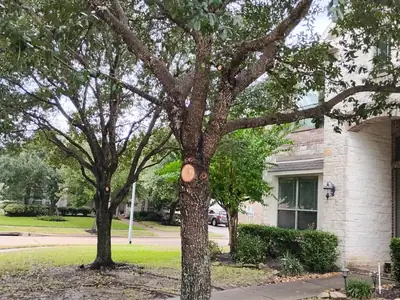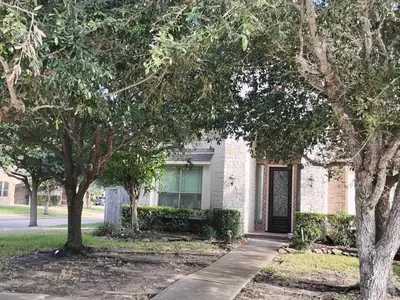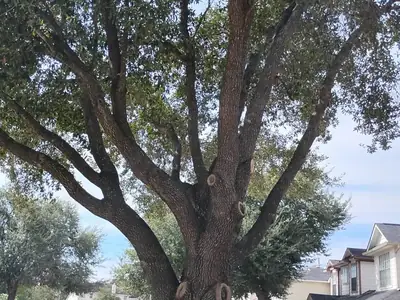
Pruning helps a tree, until it doesn’t. Every branch you remove takes away leaves the tree uses to make food, and every cut is a wound the tree has to seal. So how much you take off matters as much as what you take off.
Here is the guideline arborists follow, based on the International Society of Arboriculture (ISA), and the mistakes that cause the most damage.
The rule: no more than 25% at once, less for mature trees
The ISA guideline is that no more than 25% of a tree’s crown should be removed at one time, and less for mature trees.
Why less for mature trees? An older tree has less energy in reserve and seals wounds more slowly than a young, vigorous one. A heavy pruning that a young tree handles well can set a mature live oak back for years.
That is one reason we put so much weight on structural pruning for young trees. Corrections made early are small, and the tree barely notices them. The same correction on a mature tree means bigger cuts and more stress.
How you cut matters as much as how much
Even a light pruning can hurt a tree if the cuts are wrong. The ISA basics:
- Cut just outside the branch collar. The collar is the slightly swollen area where a branch joins the trunk. That’s where the tree is built to seal a wound.
- Never make flush cuts. Cutting flat against the trunk removes the collar and can cause dead spots and decay.
- Don’t leave long stubs. A stub can’t seal properly and becomes an entry point for decay.
- Use three cuts on large limbs. First an undercut about 12–18 inches out from the trunk, then a top cut farther out to drop the limb, then a final cut back to the collar. This keeps the bark from tearing down the trunk.
Every cut we make follows ANSI A300 pruning standards and ISA best management practices.
Common over-pruning mistakes
- Topping. Cutting the top of a tree back to stubs is the worst offender. Read why we never top trees.
- Stripping the inside of the canopy. Removing most inner branches and leaving foliage only at the ends of limbs (“lion’s tailing”) puts weight at the tips and makes limbs more likely to break.
- Removing too many lower limbs at once. Raising a canopy for clearance is fine, but taking it too high, too fast weakens the trunk.
- Pruning heavily at the wrong time. The ISA advises against heavy pruning of live tissue just after the spring growth flush. For oaks in Texas, avoid pruning February through June because of oak wilt.
- Trying to do it all in one visit. If a tree needs a lot of work, it is often better to spread it over more than one season.
Frequently asked questions
Can you trim too much off a tree?
Yes. Removing too much of the crown at once stresses the tree, triggers weak regrowth and opens it to decay. The ISA guideline is no more than 25% at once, and less for mature trees.
How much of a tree can you cut before damaging it?
Keep it to 25% of the crown or less in a single pruning, and less on mature trees. Just as important: make proper cuts at the branch collar, and don’t top the tree or strip its inner canopy.
What are the most common mistakes when pruning?
Topping, flush cuts, leaving stubs, stripping the inner canopy, removing too many lower limbs at once, and heavy pruning at the wrong time of year.
Can a tree recover from over-pruning?
Many trees recover over several seasons if the remaining crown is healthy. Don’t try to “fix” it with another heavy pruning. Give the tree time, and have an arborist assess it and plan any corrective work gradually. A tree health inspection is a good place to start.
Not sure how much your trees need? Tree Heroes provides tree trimming and pruning in Cypress, TX and along the 290 corridor, done to arborist standards. Request a quote.